
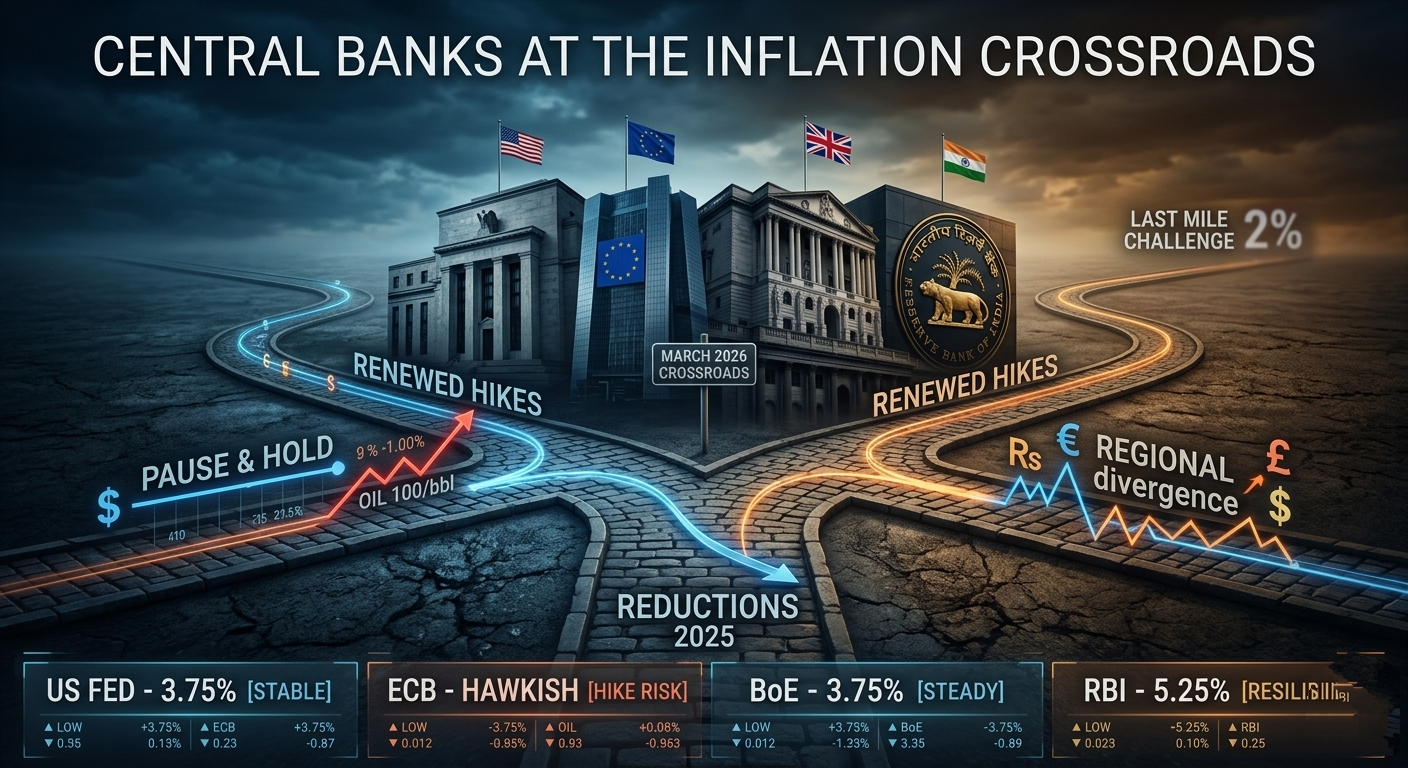
2026 is shaping up to be one of the most consequential years for the global economy in decades. Inflationary aftershocks, geopolitical rivalries, and technological disruption are converging to test the resilience of markets and policymakers alike. Financial Times reporting underscores how central banks, investors, and governments are recalibrating strategies to balance growth with stability. This blog dives deep into the forces shaping the financial landscape and what they mean for businesses, investors, and households worldwide.
Inflation: The Persistent Shadow
Despite aggressive interest rate hikes over the past two years, inflation remains stubbornly above target in many economies.
- United States: The Federal Reserve faces a delicate balancing act. While inflation has cooled from its peak, wage growth and consumer demand remain strong, complicating efforts to bring prices back to the 2% target.
- Europe: The European Central Bank (ECB) is caught between divergent member states. Southern economies demand stimulus to support growth, while northern states push for fiscal discipline.
- Emerging Markets: Countries like Turkey, Argentina, and Nigeria continue to battle double-digit inflation, exacerbated by currency weakness and import dependency.
The persistence of inflation highlights that monetary policy alone cannot solve structural supply-side issues such as energy shocks and global logistics bottlenecks.
Geopolitical Tensions: Markets on Edge
Geopolitics has become a defining variable in economic forecasting.
- Energy Markets: Middle East tensions and Russia’s ongoing confrontation with the West keep oil and gas prices volatile. Europe’s reliance on LNG imports underscores its vulnerability.
- China’s Slowdown: Once the engine of global growth, China now faces demographic decline, property market instability, and trade restrictions from Western economies.
- Currency Wars: The dollar’s strength has pressured emerging markets, raising debt servicing costs and fueling capital flight.
Investors are increasingly pricing in geopolitical risk as a permanent feature of global markets rather than a temporary shock.
Technology and Energy: Engines of Transformation
Two sectors—technology and energy—are driving structural change.
- Artificial Intelligence: AI adoption is accelerating productivity gains across industries, from finance to healthcare. Yet regulatory debates around privacy, bias, and labor displacement remain unresolved.
- Renewable Energy: Governments are doubling down on green investments, spurred by climate commitments. Solar, wind, and hydrogen projects are attracting record capital inflows.
- Fossil Fuels: Despite the green push, fossil fuels remain indispensable. OPEC’s production decisions continue to sway global energy prices.
The interplay between tech innovation and energy transition will define winners and losers in the coming decade.
Investor Strategies in Uncertain Times
Navigating volatility requires discipline and diversification.
- Equities: Tech and healthcare remain resilient, while cyclical sectors like manufacturing face headwinds.
- Commodities: Gold demand is surging, particularly in India and the Middle East, as investors seek safe havens.
- Alternative Assets: Private equity and venture capital are pivoting toward resilient sectors such as green technology and digital infrastructure.
- Fixed Income: Bonds are regaining appeal as yields rise, offering stability amid equity market turbulence.
The overarching theme is resilience—investors are prioritizing assets that can withstand shocks rather than chasing speculative growth.
The Road Ahead: Risks and Opportunities
- Fragmentation of Global Trade: Strategic blocs are forming around critical resources such as semiconductors and rare earths.
- Climate Policy: Carbon pricing, emissions regulations, and green subsidies will reshape industries from automotive to agriculture.
- Digital Currencies: Central Bank Digital Currencies (CBDCs) are gaining traction, potentially redefining monetary systems.
- Demographics: Aging populations in advanced economies and youth bulges in Africa and South Asia will create divergent growth trajectories.
The challenge for policymakers is to foster cooperation in a world increasingly defined by fragmentation.
FAQ
Q1: Why is inflation still high despite rate hikes?
Supply-side shocks (energy, logistics) persist alongside strong consumer demand.
Q2: Which sectors are most resilient in 2026?
Technology, healthcare, and renewable energy show strong fundamentals.
Q3: How should investors hedge against volatility?
Diversification, gold, and exposure to emerging green technologies are recommended.
Conclusion
2026 is not just another year in the economic cycle—it is a turning point. Inflationary pressures, geopolitical rivalries, and technological disruption are converging to reshape the global order. For investors, adaptability and foresight are the ultimate currencies of success. For policymakers, the task is to balance stability with innovation. The Financial Times rightly frames this moment as one of profound uncertainty, but also of immense opportunity.
Reference
https://www.bing.com/search?q=%22https%3A%2F%2Fwww.imf.org%2Fen%2FPublications%2FWEO%22