
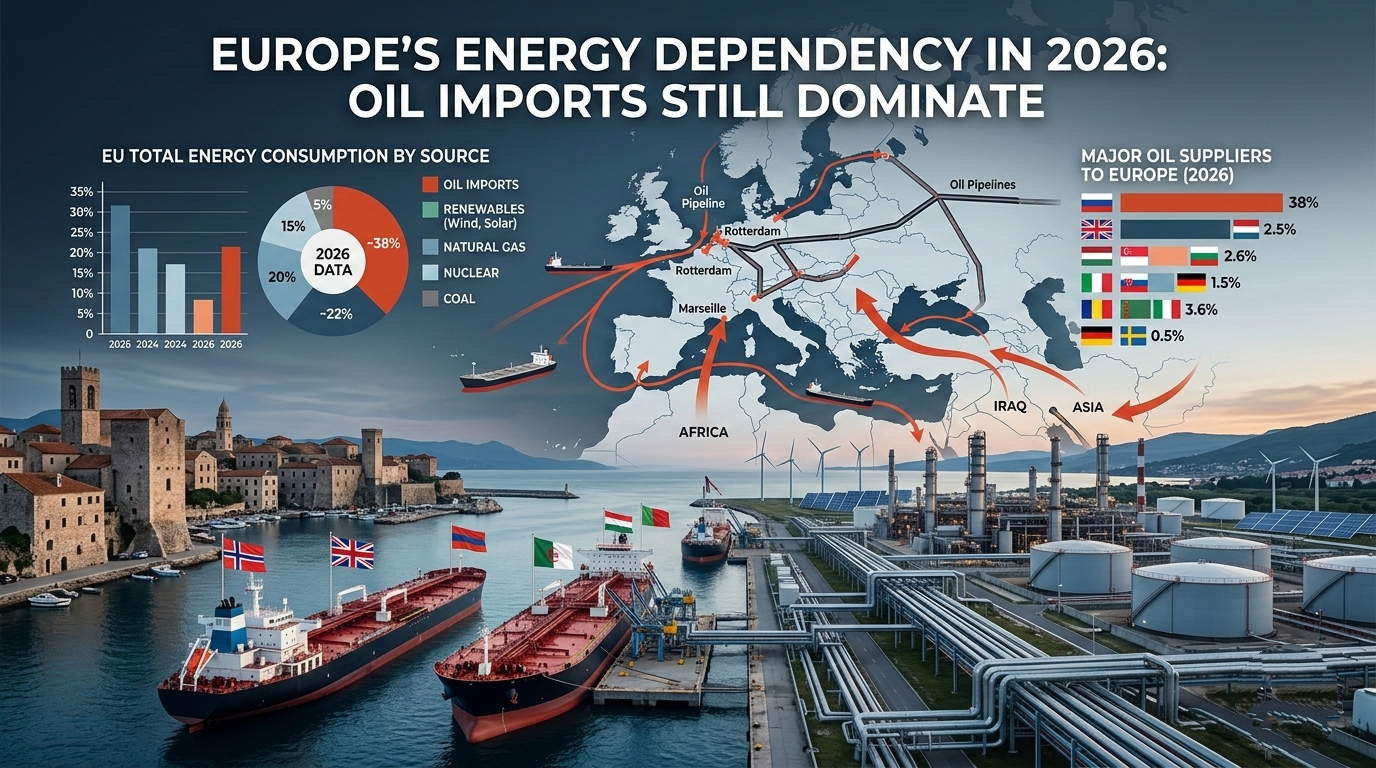
Energy has always been the lifeblood of Europe’s economy. From powering industries to heating homes, the continent’s prosperity depends on a steady flow of resources. Yet, the latest Eurostat report (March 2026) reveals a sobering reality: the EU remains heavily dependent on imports, with 57% of its energy needs in 2024 covered by external suppliers. Oil and petroleum products dominate this equation, accounting for 67% of imports, while renewables barely register at 2%.
This dependency is not just a statistic—it is a story of geopolitics, economics, and the urgent need for transformation.
The Breakdown: What Fuels Europe?
Oil & Petroleum Products (67%)
Oil remains the king of Europe’s energy imports. The United States emerged as the largest supplier, providing 16% of EU oil imports. Despite efforts to diversify, Europe’s reliance on oil ties its fortunes to global markets and geopolitical tensions.
Natural Gas (24%)
Gas dependency is equally significant. Norway supplied 30% of EU gas imports, reinforcing its role as a critical energy partner. Yet, the shadow of past reliance on Russia lingers, reminding policymakers of the risks of overdependence.
Solid Fossil Fuels (Coal) (4%)
Coal imports have dwindled, reflecting Europe’s climate commitments. Still, Australia remains the largest supplier, accounting for 31% of coal imports.
Electricity (3%) & Renewables (2%)
Cross-border electricity trade and renewable imports remain marginal. The fact that renewables make up only 2% of imports highlights Europe’s slow progress in scaling sustainable alternatives.
Country Disparities: Who Depends the Most?
The EU average dependency rate masks sharp contrasts among member states.
- Highest dependency:
- Malta (98%)
- Luxembourg (91%)
- Cyprus (88%)
These nations are almost entirely reliant on imports, leaving them vulnerable to external shocks.
- Lowest dependency:
- Estonia (5%)
- Sweden (27%)
- Latvia (29%)
Estonia’s near self-sufficiency is remarkable, driven by domestic energy production and diversification strategies.
Why This Matters: Risks & Realities
Geopolitical Vulnerability
Europe’s reliance on external suppliers makes it susceptible to global crises. Conflicts, sanctions, or supply chain disruptions can ripple across the continent, driving up prices and threatening stability.
Economic Volatility
Energy prices are notoriously volatile. For businesses and households, this translates into unpredictable costs, inflationary pressures, and reduced competitiveness.
Climate Commitments vs. Reality
Despite ambitious climate goals, Europe’s energy mix remains dominated by fossil fuels. The marginal role of renewables in imports underscores the gap between policy aspirations and practical outcomes.
Strategic Implications for Policymakers
Accelerate Renewable Adoption
Europe must scale domestic renewable production—solar, wind, and hydro—to reduce reliance on oil and gas.
Strengthen Intra-EU Energy Trade
Building stronger internal networks and storage capacity can cushion against external shocks.
Diversify Suppliers
Reducing dependence on a handful of countries is critical for resilience.
Invest in Innovation
Hydrogen, battery storage, and smart grids can reshape Europe’s energy future.
Implications for Businesses & Consumers
- Price Volatility: Expect continued fluctuations tied to global oil and gas markets.
- Supply Risks: Countries with high dependency may face shortages during crises.
- Opportunities: Energy-efficient technologies and local renewables will gain traction, offering businesses a competitive edge.
Storytelling Flow: Europe at a Crossroads
Imagine a household in Malta, where nearly all energy comes from imports. A sudden disruption in oil supply could mean soaring electricity bills and fuel shortages. Contrast this with Estonia, where domestic production shields families from global turbulence.
This disparity illustrates Europe’s crossroads: continue down the path of dependency, or invest boldly in renewables and resilience.
FAQ
Q1: What is the EU’s overall energy dependency rate?
57% in 2024
Q2: Which energy source dominates EU imports?
Oil and petroleum products (67%).
Q3: Which countries are most dependent on imports?
t A: Malta (98%), Luxembourg (91%), Cyprus (88%).
Q4: Which countries are least dependent?
Estonia (5%), Sweden (27%), Latvia (29%).
Q5: What role do renewables play in imports?
Just 2%, highlighting the need for expansion.
Conclusion
The Road AheadEurope’s energy dependency is more than a statistic—it is a challenge to sovereignty, stability, and sustainability. The Eurostat report is a wake-up call: without decisive action, Europe’s future will remain tethered to external suppliers and fossil fuels.
R The solution lies in renewable expansion, supplier diversification, and stronger internal networks. The time for incremental change has passed; Europe must embrace transformation.
Refrance
https://ec.europa.eu/eurostat/web/products-eurostat-news/w/wdn-20260318-1