
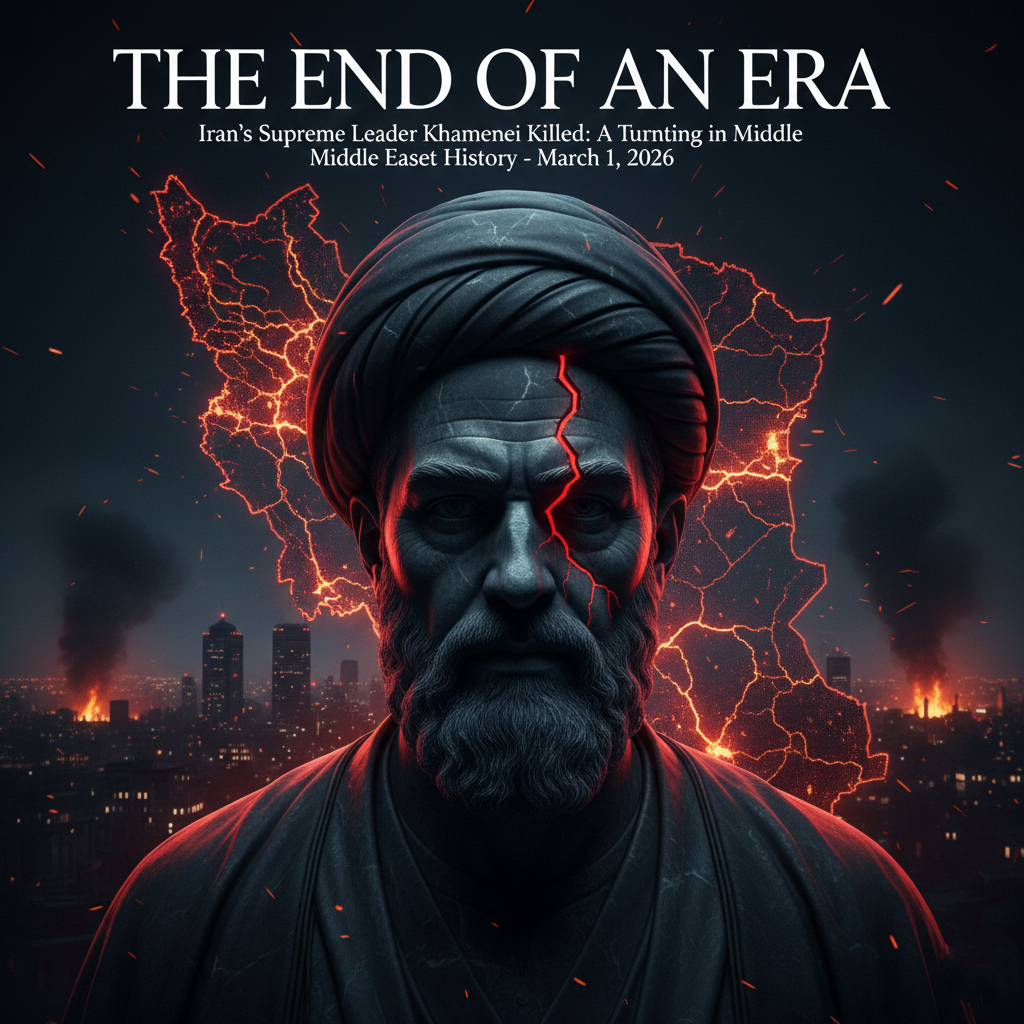
History has shifted overnight. Iran’s Supreme Leader Ayatollah Ali Khamenei, who ruled the country for nearly four decades, has been killed in coordinated U.S.–Israeli strikes. For a nation built on his authority, the news is more than a headline — it is the unraveling of a political era. The Middle East, already fragile, now faces a storm of uncertainty.
The Man Who Defined Iran’s Modern Path
Khamenei rose to power in 1989, succeeding Ayatollah Khomeini. For decades, he shaped Iran’s foreign policy, oversaw its nuclear ambitions, and maintained a tight grip on domestic politics. His leadership was marked by defiance against the West, support for regional proxy groups, and a vision of Iran as a revolutionary power.
The Strike That Changed Everything
- U.S. and Israeli forces launched one of the most ambitious attacks on Iranian targets in decades.
- Iranian state media confirmed Khamenei’s death, describing it as an “unprovoked and illegal act.”
- Retaliation was swift: Iran fired missiles at Israel and U.S. bases across the Gulf.
This was not just a military operation — it was a direct blow to the heart of Iran’s theocratic system.
Human Impact
For ordinary Iranians, the news is surreal. Streets are filled with grief, confusion, and anger. In Israel, families rushed to shelters as missile sirens echoed. Across the Gulf, civilians brace for fallout, knowing their countries host U.S. bases that could be targeted.
Global Reactions
- United States: President Donald Trump hailed the strike as “justice,” calling for regime change in Iran.
- Israel: Officials described the operation as necessary to neutralize Iran’s growing threat.
- United Nations: Urged restraint, warning of catastrophic consequences if escalation continues.
- Regional Powers: Saudi Arabia, Turkey, and others are watching closely, aware that instability could spill across borders.
What Comes Next
The death of Khamenei leaves Iran in a dangerous power vacuum. Questions loom:
- Who will succeed him, and can the clerical establishment maintain control?
- Will Iran’s Revolutionary Guard tighten its grip, or will reformist voices emerge?
- Could this be the spark for a wider regional war, pulling in Hezbollah, Syria, and Gulf states?
FAQs
Q: Why was Khamenei targeted?
The U.S. and Israel accused him of orchestrating attacks and destabilizing the region.
Q: What does this mean for Iran’s future?
Without Khamenei, Iran faces internal divisions and external pressure, making its future highly uncertain.
Q: Could this lead to global economic shocks?
Yes. Oil markets are already reacting, and prolonged conflict could disrupt global supply chains.
Conclusion
Ayatollah Khamenei’s death marks the end of an era and the beginning of a volatile chapter in Middle Eastern history. For Iranians, it is a moment of grief and fear. For the world, it is a reminder that the region’s conflicts are never contained — they ripple outward, touching economies, politics, and lives across the globe.
Reference