
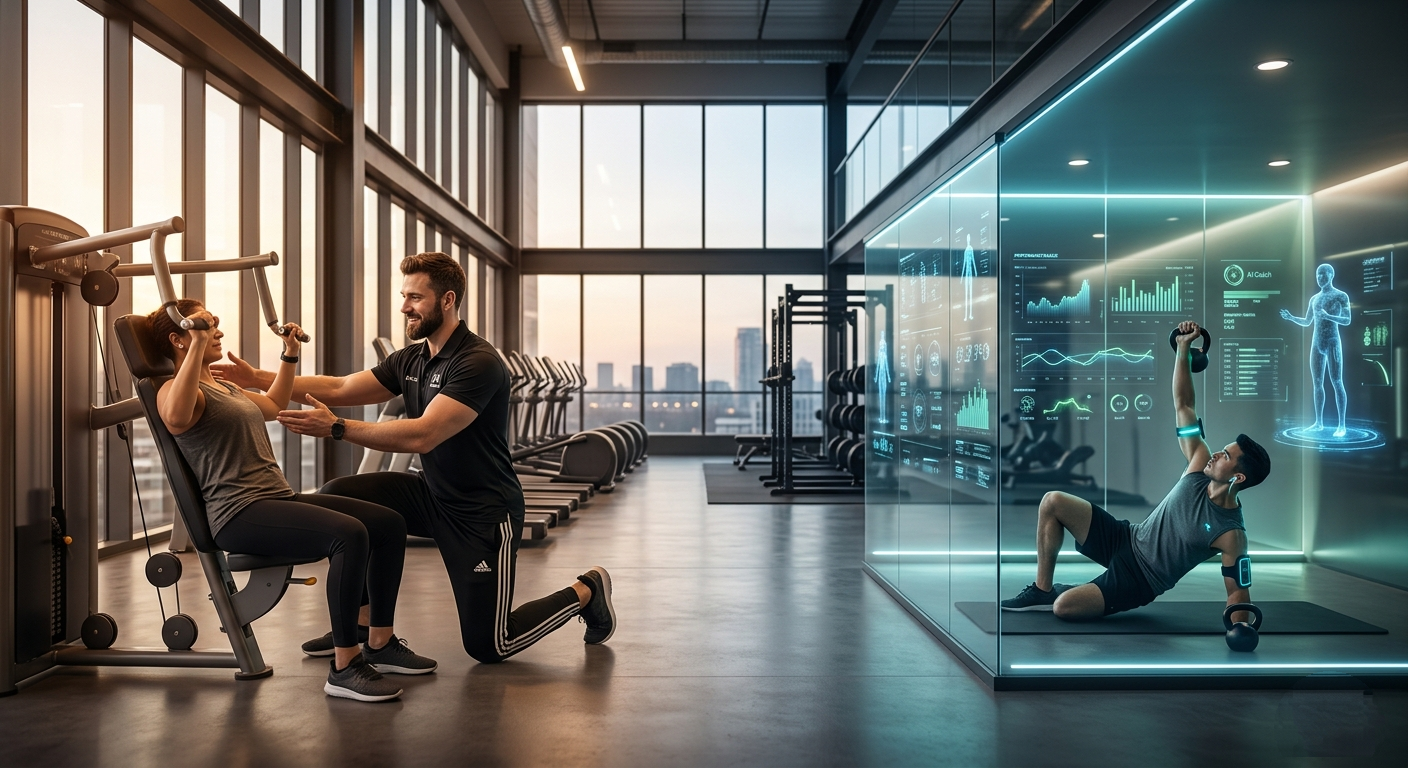
The fitness industry is undergoing a seismic shift. Once defined by sweat-soaked gyms and one-on-one coaching, it is now being reshaped by artificial intelligence. Platforms like Future and Caliber are pioneering a model where AI-powered training engines deliver scalable, personalized workouts, while human trainers are repositioned as premium, luxury services.
This transformation raises a provocative question: Will human personal trainers soon be reserved only for the wealthy?
The Rise of AI Fitness Platforms
Future’s Bold Experiment
Future, a fitness app that recently merged with Tom Brady’s Autograph, is testing a hybrid model:
- AI Coaching Engine: Built from millions of workouts and coaching data, capable of tailoring routines at scale.
- Voice Personalization: Users can select coaching personalities, making the AI feel more human.
- Human Coaches: Still available, but only for premium subscribers willing to pay extra.
Caliber’s Strategy
Caliber, another fast-growing platform, mirrors this approach:
- AI handles mainstream coaching.
- Human trainers are marketed as elite, high-touch services.
Together, these companies are redefining personal training as a tiered experience: AI for the masses, humans for the few.
Why Human Trainers Are Becoming a Luxury
1. Cost Efficiency
AI coaching is cheaper to scale. Human trainers require time, scheduling, and higher fees, making them less accessible to average users.
2. Personalization at Scale
AI can deliver tailored workouts using data-driven insights, reducing reliance on one-on-one human guidance.
3. Market Strategy
Fitness apps are monetizing exclusivity—human trainers are marketed as luxury add-ons, not the default.
Benefits of AI Coaching
- Accessibility: AI trainers can reach millions at once, lowering barriers to entry.
- Consistency: Algorithms ensure structured, data-backed routines.
- Customization: AI adapts workouts based on user progress, goals, and preferences.
- Engagement: Features like voice personalities make the experience more interactive.
Risks & Trade-offs
- Loss of Human Touch: Motivation, empathy, and nuanced feedback from real trainers may be missing.
- Over-reliance on Data: AI personalization depends on accurate input; poor data can lead to ineffective routines.
- Exclusivity Gap: Fitness may become stratified—AI for the masses, humans for the wealthy.
AI vs Human Trainers: A Side-by-Side Comparison
| Feature | AI Trainers (Future/Caliber) | Human Trainers |
|---|---|---|
| Cost | Low / subscription-based | High / premium |
| Personalization | Data-driven, scalable | Deeply tailored, empathetic |
| Availability | 24/7, global reach | Limited, scheduled |
| Motivation | Gamified, voice personalities | Emotional, real-time feedback |
| Exclusivity | Mass-market | Luxury service |
Storytelling Flow: A Glimpse Into Tomorrow
Imagine a young professional in New York City. She wakes up, straps on her smartwatch, and her AI trainer instantly adjusts her workout based on sleep quality, stress levels, and yesterday’s performance.
She feels guided, motivated, and supported—yet she has never met her trainer in person. For her, AI is enough.
Meanwhile, a CEO in Silicon Valley pays thousands per month for a human trainer who not only designs workouts but also provides emotional support, accountability, and lifestyle coaching.
This contrast illustrates the future divide: AI-driven fitness for the majority, human coaching as a luxury for the elite.
The Bigger Picture: Fitness as a Stratified Industry
The shift toward AI coaching reflects broader trends in technology:
- Automation replacing human labor in scalable industries.
- Luxury positioning of human expertise in health, education, and wellness.
- Data-driven personalization becoming the new standard.
Just as private chefs are a luxury compared to meal delivery apps, human trainers may soon be seen as a luxury compared to AI fitness engines.
FAQ
Q1: Will AI completely replace human trainers?
Not entirely—human trainers will remain valuable for elite clients, rehabilitation, and highly personalized needs.
Q2: Are AI trainers effective?
Yes, they can deliver structured, adaptive workouts, but they lack the emotional intelligence of human coaches.
Q3: Is this shift good for fitness accessibility?
Yes, AI lowers costs and expands reach, but it risks creating a divide between mass-market and luxury fitness.
Conclusion
The fitness industry is entering an AI-first era, where scalable coaching engines dominate. Human trainers are not disappearing but are being repositioned as luxury services for those who can afford personalized, empathetic guidance.
For most users, AI will provide accessible, adaptive, and cost-effective fitness solutions. Yet the human touch—empathy, motivation, and accountability—will remain priceless, reserved for those willing to pay for it.
Reference
https://athletechnews.com/age-of-ai-human-personal-trainers-might-become-a-luxury-future-caliber/