
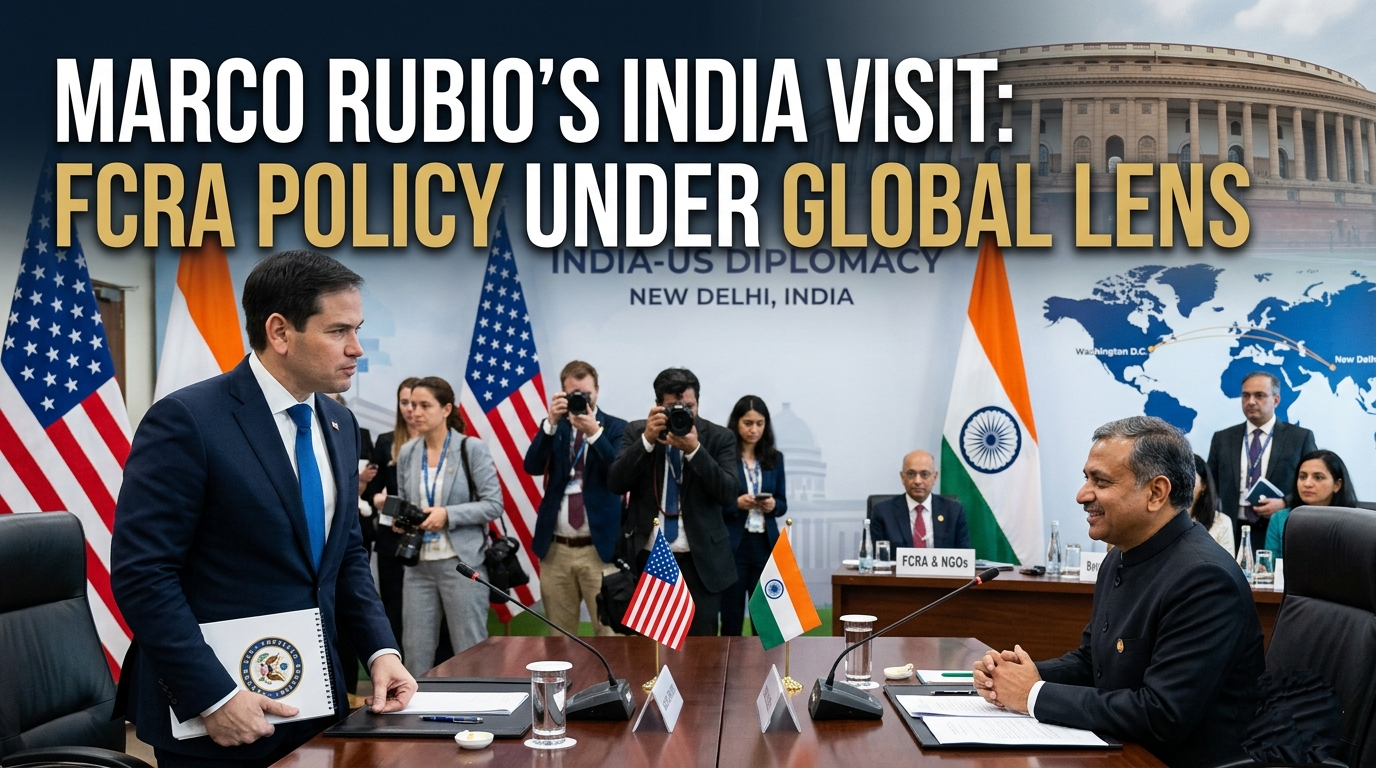
Diplomacy often reveals itself in symbolic gestures, and U.S. Senator Marco Rubio’s recent visit to India was one such moment. His stop at the Missionaries of Charity wasn’t just a humanitarian courtesy — it was a calculated move that placed India’s Foreign Contribution Regulation Act (FCRA) under sharp international scrutiny. Coming right after the US-China summit, the timing amplified its geopolitical significance.Rubio’s visit highlights the growing tension between India’s domestic policies and its global image. As India positions itself as a leader in the Indo-Pacific, the way it balances sovereignty with civil society freedoms will shape its credibility worldwide.
What is the FCRA?
- The FCRA policy was introduced to regulate foreign donations to NGOs in India.
- Government’s stance: Safeguards sovereignty, prevents misuse of funds, and ensures transparency.
- Critics’ view: Restrictive, disproportionately affecting missionary and human rights groups.
- Impact: NGOs in health, education, and humanitarian aid face funding uncertainty.
- This tension between sovereignty and civil society freedoms lies at the heart of the debate.
🌍 Rubio’s Symbolic Stop
Rubio’s visit to the Missionaries of Charity carried powerful symbolism.
- Historical context: Founded by Mother Teresa, the NGO has faced repeated FCRA license suspensions.
Diplomatic signal: Rubio’s stop highlighted U.S. concerns over religious freedom and civil society space in India.
Strategic timing: Coming after the US-China summit, the move underscored Washington’s balancing act in Asia.
⚖️ India’s Dilemma
India faces a delicate balancing act:
- National sovereignty vs. global image: While FCRA is defended as essential, restrictive policies risk harming democratic credentials.
Civil society impact: Grassroots organizations struggle with funding uncertainty.
Diplomatic strain: Strong U.S.-India ties in defense and trade may face friction over civil society issues.
📊 Comparative View
| Aspect | India’s Position | Global/U.S. View |
|---|---|---|
| FCRA Policy | Protects sovereignty | Restrictive, limits NGO freedom |
| Missionaries of Charity | Compliance checks | Symbol of religious freedom |
| Diplomatic Timing | Post US-China summit | Strategic pressure on India |
| Impact on Relations | Possible soft diplomacy strain | Opportunity to push human rights |
🔎 Geopolitical Implications
Rubio’s visit was more than symbolic — it was strategic.
- Strategic messaging: Signals U.S. intent to spotlight civil society freedoms in India.
- Pressure on India: Adds international scrutiny to Modi’s governance style.
- Global spotlight: India’s domestic policies are increasingly tied to its global credibility.
📖 Storytelling Flow
Imagine India as a stage where sovereignty and democracy perform side by side. The FCRA is the script — strict, precise, and protective. But Rubio’s visit introduced a new character: international scrutiny. Suddenly, the script is questioned, and the audience — global civil society — wonders whether India’s democratic ideals align with its restrictive policies.
This narrative isn’t just about NGOs. It’s about India’s global identity. As the Indo-Pacific becomes the center of power competition, every domestic policy resonates internationally.
Broader Context
- India-US relations: While defense and trade ties remain strong, civil society issues could become friction points.
- US-China rivalry: Rubio’s timing suggests Washington’s intent to balance influence in Asia.
- Civil society freedoms: India’s democratic credentials are increasingly judged by how it treats NGOs and minority groups.
Conclusion
Rubio’s India visit was a calculated diplomatic move. By spotlighting the FCRA policy, the U.S. has placed India’s civil society freedoms under the global lens. As India positions itself as a leader in the Indo-Pacific, the balance between sovereignty and civil society freedoms will define its international reputation.
FAQ
What is FCRA?
A law regulating foreign donations to NGOs in India.
Why is it controversial?
Critics say it restricts religious and humanitarian organizations, while the government argues it protects sovereignty.
Why did Rubio visit Missionaries of Charity?
To highlight U.S. concerns over religious freedom and civil society space in India.
How does this affect India-US relations?
It may add friction in soft diplomacy, even as strategic cooperation remains strong.